
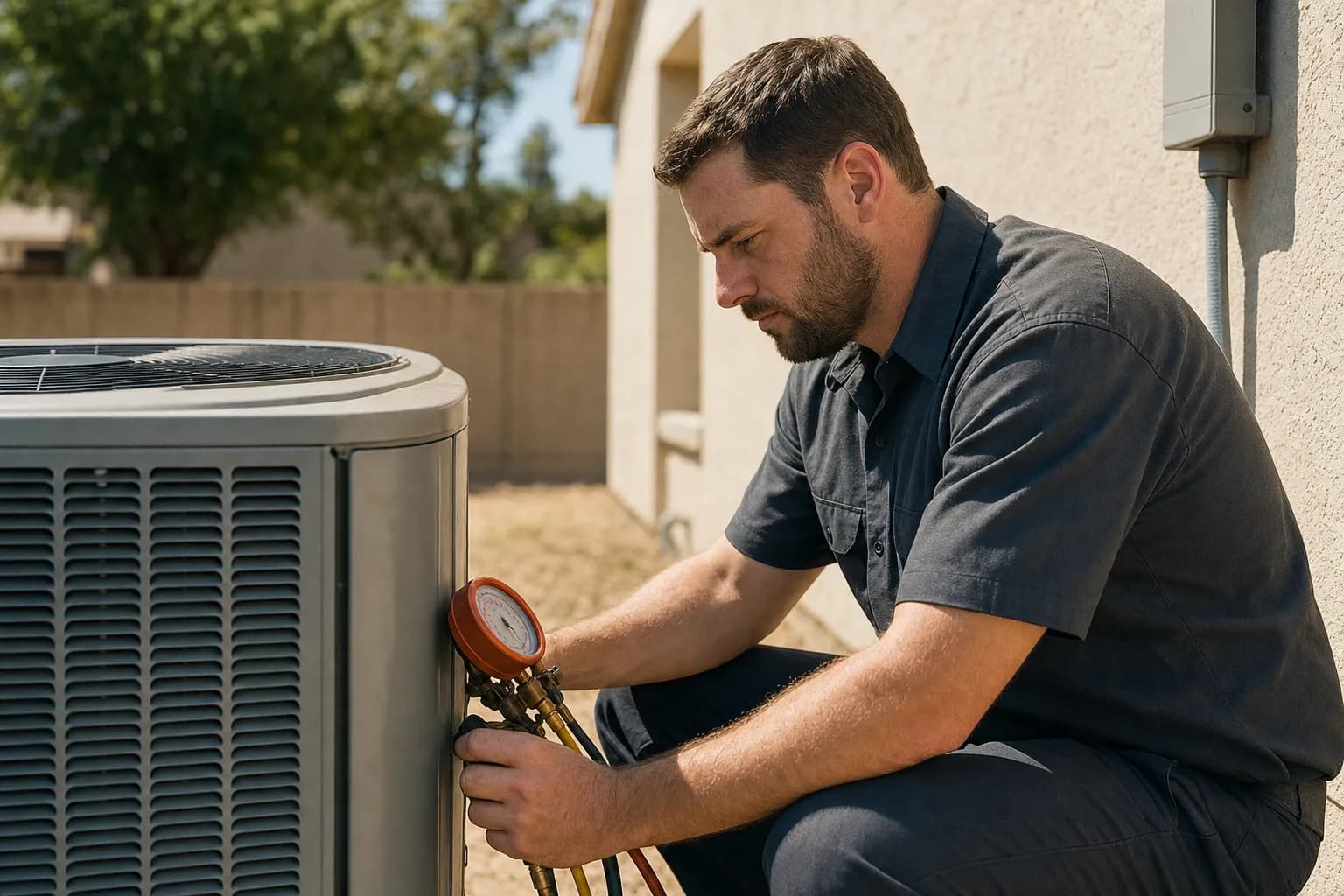
HVAC marketing in 2026 is not about being everywhere. It's about being in the right place at the exact moment a homeowner's AC dies in August heat or their furnace stops in January cold. That moment, the one where someone reaches for their phone and types "AC repair near me" while their house is 90 degrees inside, is where HVAC marketing either works or doesn't.
The Bureau of Labor Statistics projects 8% employment growth for HVAC technicians through 2034, much faster than average, with about 40,100 openings per year. The U.S. HVAC services market generates over $150 billion annually across roughly 125,000 contractor businesses. Demand is massive and growing. But more demand also means more contractors fighting for the same homeowner on the same search results page.
The HVAC companies winning in 2026 aren't the ones with the biggest budget. They're the ones running a system where every channel, paid search, Local Service Ads, SEO, Google Business Profile, Meta Ads, website, and reputation, works together to capture calls across every point the customer might look. One channel alone isn't enough anymore. The search results page for "AC repair near me" now shows five distinct placements, and the company showing up in three of them gets the call over the one showing up in one.
This article covers each channel with the depth you'd actually need to execute it. Not theory. Not "invest in SEO." Real tactics, real keyword examples, real campaign structures.
IN THIS ARTICLE
- 1Why HVAC seasonality makes channel strategy harder (and more rewarding when you get it right)
- 2How to structure Google Ads for HVAC by service type with keyword-level detail
- 3What Local Service Ads do for HVAC companies and how to run them profitably
- 4The SEO architecture that turns your HVAC website into a compounding lead asset
- 5How to operate your Google Business Profile as a weekly lead generation system
- 6What your HVAC website needs to convert the traffic every other channel sends
- 7How Meta Ads build HVAC brand awareness that converts weeks later
- 8The reputation engine that makes every completed HVAC job feed your next one
Keep reading to get the full channel breakdown, built for how HVAC businesses actually operate.
Why HVAC seasonality makes channel strategy harder (and more rewarding when you get it right)
HVAC is the most seasonal trade in home services. Your busiest month can generate five times the call volume of your slowest month, and the swing happens fast. A 105-degree week in Phoenix or a polar vortex in Chicago creates a demand spike that overwhelms any company that isn't already positioned. By the time you try to ramp up marketing during peak, your competitors have already locked in the rankings, the ad positions, and the LSA slots.
Seasonality shapes everything about how HVAC marketing works.
The two demand cycles and what they mean for your marketing calendar
HVAC demand runs on two cycles. The cooling cycle peaks from May through September in most markets, with emergency AC repair as the highest-volume, highest-urgency service. The heating cycle runs from October through March, with furnace repair and heating system failures driving calls. Spring and fall shoulder seasons see lower emergency volume but higher replacement and maintenance interest as homeowners prepare for the coming peak.
Your marketing calendar has to lead the demand, not follow it. Here's what that looks like in practice:
- January through March: publish AC content (maintenance tips, efficiency guides, replacement comparisons) so pages are indexed and ranking by May
- April through May: increase PPC and LSA budgets for cooling services before the first heat wave
- June through September: maintain maximum PPC spend on AC repair and installation keywords, scale back heating content
- August through September: publish heating content (furnace maintenance, heat pump guides, winterization checklists) for the fall cycle
- October through November: shift PPC and LSA budgets toward heating keywords, scale back cooling spend
- December through February: maintain heating-focused spend, begin planning spring AC content
The HVAC companies that publish AC content in January and boost ad spend in April are the ones sitting in position one when the phones explode in July. The ones that start thinking about summer marketing in June are already three months behind.
High tickets change the math on every channel
HVAC has some of the highest average ticket values in home services. A full AC system replacement runs $5,000 to $15,000 depending on market and system type. Even a repair call averages $200 to $600. That changes the economics of every marketing channel.
A cost per lead of $150 that would be unprofitable for a $200 drain cleaning call is perfectly profitable for a $7,000 AC replacement. The math:
- $150 cost per lead, 30% close rate means $500 per booked job
- Average replacement job at $7,000 with a 25% profit margin means $1,750 gross profit
- $500 marketing cost on $1,750 profit is a 3.5x return
This math is why HVAC companies can afford to bid aggressively on high-intent keywords and still generate strong ROI. The playbook is to identify which service lines carry the highest tickets, direct your marketing budget disproportionately toward those services, and build the tracking infrastructure to prove the return.
According to the U.S. Department of Energy, heating and cooling accounts for around 35% of all energy consumption in buildings, the largest share attributable to any single end use. That stat matters for your marketing because it means homeowners spend more on HVAC than almost any other system in their home, and they'll spend more when they understand the energy cost of a failing system. Your content and your ad copy should use this reality to frame replacement as a financial decision, not just a comfort one.
How to structure Google Ads for HVAC by service type
Google Ads puts your business in front of homeowners at the moment of highest intent. "AC not working," "furnace repair near me," "emergency HVAC service," these are people who need help now and will call whoever appears first with a credible ad. But HVAC PPC is expensive in competitive markets, and a poorly structured campaign will eat through your budget on clicks that never convert.
The key to profitable HVAC PPC is segmentation. Every service line needs its own campaign or ad group with its own keywords, its own ad copy, and its own landing page.
Campaign structure with real keyword examples
AC repair is your volume driver during cooling season. Target keywords like "AC repair near me," "AC not cooling," "air conditioner repair [city]," "central air not working," "AC blowing warm air," and "emergency AC repair." Ad copy should lead with fast response time and 24/7 availability. The landing page needs a tappable phone number above the fold, your license information, and a clear mention of same-day or emergency service.
AC installation and replacement is your high-ticket campaign. Keywords include "AC replacement [city]," "new air conditioner installation," "central AC cost," "HVAC system replacement," and "AC unit price." Ad copy should emphasize free estimates, financing options, and energy efficiency. The landing page needs more depth than the repair page because the buyer is in research mode: system options, brand information, efficiency ratings, and a strong financing CTA alongside the phone number.
Heating repair catches the winter cycle. Target "furnace repair near me," "heater not working," "no heat in house," "furnace repair [city]," "heat pump not heating," and "emergency heating repair." Mirror the AC repair structure with winter-specific ad copy: 24/7 availability, fast response, and "don't wait in the cold."
Heating installation targets the replacement buyer. Keywords: "furnace replacement [city]," "heat pump installation [city]," "new heating system cost," and "furnace installation near me." Same high-ticket principles as AC installation: free estimates, financing, efficiency.
Maintenance and tune-up is your shoulder-season campaign. "AC tune-up [city]," "HVAC maintenance near me," "furnace tune-up [city]," and "AC maintenance plan." Lower intent than repair or replacement, but these leads often convert into maintenance agreements that generate recurring revenue and future replacement sales.
Ductwork and indoor air quality is a supporting campaign for HVAC companies that offer these services. "Duct cleaning [city]," "duct sealing," "air quality testing," "HVAC duct repair," and "whole house air purifier." Lower volume but often less competitive and good margin.
The negative keywords that protect HVAC budgets
HVAC keywords attract a massive volume of irrelevant searches. Without a negative keyword list built from day one and updated weekly, you'll pay for clicks from:
- DIY searches: "how to fix AC," "furnace troubleshooting guide," "reset thermostat"
- Parts and supplies: "AC capacitor," "furnace filter size," "HVAC refrigerant"
- Career searches: "HVAC technician salary," "HVAC apprenticeship," "HVAC certification"
- Brand and model research: "Carrier AC reviews," "Trane vs Lennox" (unless you're specifically targeting brand comparisons)
- Commercial and industrial: "commercial HVAC contractor," "rooftop unit repair" (unless you serve commercial clients)
Check your search terms report at least twice per week during peak season. One bad week of irrelevant clicks during a July heat wave can burn through hundreds of dollars that should have been spent on emergency AC repair leads.
Landing pages built for HVAC conversions
Your HVAC landing pages need to match the intent of the search that brought the visitor there. An AC repair landing page should look and feel different from an AC replacement page because the buyer is in a different state of mind.
The emergency repair landing page is built for speed. Phone number, tappable, top of the page. One sentence: "24/7 emergency AC repair in [City]. Licensed, insured, same-day service." Trust signals below: review count and rating, license number, "family-owned since [year]." A form for people who prefer to type. No navigation menu. Nothing that creates friction between the visitor and the call.
The replacement and installation landing page is built for consideration. The visitor is comparing options, so give them what they need: system types you install, brands you carry, efficiency ratings, financing options, and a free estimate CTA. Include a section on what the installation process looks like, how long it takes, and what to expect. This page converts more slowly but generates the highest-value leads.
Tracking that connects clicks to revenue
Every HVAC PPC campaign needs call tracking with dynamic number insertion, Google Ads conversion tracking on both calls and forms, call recording for quality control, and (ideally) CRM integration so you can trace every marketing dollar from click to booked job to completed invoice.
The reason tracking matters: an HVAC company spending $8,000 per month on Google Ads without tracking is guessing about what works. An HVAC company with tracking knows that their "AC replacement" campaign generated 14 leads at $190 each, 5 of those became jobs averaging $7,200, and the campaign produced $36,000 in revenue on $2,660 in ad spend. That's the data that lets you double down on what's profitable and cut what isn't.
What Local Service Ads do for HVAC companies and how to run them profitably
Local Service Ads sit above everything else on the search results page. Above PPC. Above the map pack. Above organic results. They carry the Google Guaranteed badge, and the pay-per-lead model means you only pay when someone actually contacts you. For HVAC companies in competitive markets, LSAs often deliver the lowest cost per booked job of any channel.
Verification specifics for HVAC
Google requires HVAC-specific documentation for LSA verification:
- State HVAC contractor license (or equivalent, varies by state)
- General liability insurance with adequate coverage limits
- Background checks on all customer-facing employees
- Business registration matching your Google Business Profile name exactly
The most common stalling point is a name mismatch. If your LLC is registered as "Cool Air HVAC Services LLC" but your Google Business Profile says "Cool Air Heating & Cooling," verification will reject until they match. Align all documentation before starting the process.
Profile optimization for maximum lead volume
Once live, your LSA lead volume is determined by three factors: service categories, reviews, and responsiveness.
Service categories should cover every HVAC service you offer. Don't just select "HVAC" and call it done. Add every applicable category: AC repair, AC installation, heating repair, heating installation, heat pump services, duct cleaning, thermostat installation, emergency HVAC, and any other category that matches your actual work. Each category expands the range of searches your LSA can appear for.
Reviews are the dominant ranking signal for LSAs. Your LSA shares reviews with your Google Business Profile, so every five-star Google review improves both your map pack position and your LSA ranking simultaneously. An HVAC company with 300 reviews will consistently appear above a competitor with 50 reviews, even if the competitor is closer to the searcher.
Responsiveness matters because Google tracks how quickly you respond to LSA leads. Businesses that answer calls and respond to messages within minutes rank higher than those that let leads sit for hours. During peak season, make sure someone is answering LSA leads in real time.
Dispute every bad lead
HVAC LSA leads include their share of wrong-service calls, out-of-area requests, and spam. Dispute every invalid lead within 24 hours.
Common valid disputes for HVAC companies:
- 1Caller needed plumbing, electrical, or another non-HVAC service
- 2Caller is outside your listed service area
- 3Robocall or solicitation, not a customer
- 4Duplicate lead (same person calling twice for the same issue)
Aggressive disputing recovers 15% to 30% of your LSA spend. At $3,000 per month, that's $450 to $900 returned to your budget. Multiply that by 12 months and you've recovered the cost of another marketing channel.
The SEO architecture that turns your HVAC website into a compounding lead asset
SEO for HVAC companies compounds. Every page you optimize, every link you earn, every content piece you publish adds to an organic presence that generates leads without ongoing ad spend. After 12 months of consistent SEO investment, most HVAC companies see their organic channel producing leads at a fraction of the cost of paid channels, and those leads continue flowing even if you pause other marketing.
The HVAC keyword map
Before you build or optimize any page, map every keyword to a specific URL. One primary keyword per page. No overlap.
An HVAC keyword map for a company serving a single metro area:
- AC repair: primary "AC repair [city]," secondaries "air conditioner repair," "AC not cooling," "central air repair"
- AC installation: primary "AC installation [city]," secondaries "new AC unit cost," "AC replacement," "central air installation"
- AC maintenance: primary "AC tune-up [city]," secondaries "AC maintenance," "annual AC service"
- Furnace repair: primary "furnace repair [city]," secondaries "heater repair," "furnace not working"
- Furnace installation: primary "furnace installation [city]," secondaries "new furnace cost," "furnace replacement"
- Heat pump services: primary "heat pump installation [city]," secondaries "heat pump repair," "heat pump vs furnace"
- Ductless mini-split: primary "ductless mini-split installation [city]," secondaries "mini-split cost," "ductless AC"
- Duct cleaning: primary "duct cleaning [city]," secondaries "air duct cleaning," "HVAC duct cleaning"
- Duct repair and sealing: primary "duct sealing [city]," secondaries "duct repair," "Aeroseal"
- Indoor air quality: primary "indoor air quality [city]," secondaries "air purifier installation," "whole house air cleaner"
- Emergency HVAC: primary "emergency HVAC [city]," secondaries "24 hour AC repair," "emergency furnace repair"
- Thermostat installation: primary "thermostat installation [city]," secondaries "smart thermostat setup," "Nest installation"
That's 12 service pages for a single city. If you serve 10 cities, you also need location pages: "AC repair in [City B]," "furnace repair in [City C]," and so on. A company with 12 services across 10 cities has 120 potential keyword targets, each one a separate entry point for a homeowner to find your business through organic search.
What makes an HVAC service page rank
An HVAC service page that ranks and converts includes:
A title tag in the format "[Service] in [City] | [Business Name]" under 60 characters. The H1 matches the primary keyword naturally. The opening paragraph directly answers what the service is, when a homeowner needs it, and what your company does about it. The primary keyword appears in this first paragraph.
The body goes deep with real HVAC expertise. For an AC repair page, explain the diagnostic process: what does a tech check first (thermostat, breakers, air filter), what are the common failure points (capacitor, contactor, refrigerant, compressor), and what determines whether a repair or replacement makes more sense. This isn't generic filler. It's the kind of content that demonstrates the first-hand experience and expertise that Google's E-E-A-T framework rewards.
Include a section covering signs that indicate a homeowner needs this service. For AC repair: warm air from vents, unusual noises, system short cycling, ice on the refrigerant line, high humidity indoors, spikes in the electric bill. Each symptom targets a long-tail keyword that homeowners actually search.
Internal links connect related services. The AC repair page links to AC maintenance, AC installation, thermostat services, and duct cleaning. The furnace repair page links to furnace installation, heat pump services, and emergency HVAC. This web of connections builds topical authority and passes ranking power between pages.
Every page ends with a CTA: phone number, booking form, financing mention. No dead ends.
Blog content that feeds the HVAC funnel
Strategic HVAC blog content targets specific keywords, serves specific stages of the buyer journey, and links to specific service pages.
Problem-aware content catches homeowners at the first sign of trouble. "Why is my AC freezing up?" "What does it mean when your furnace short cycles?" "Is a humming noise from your AC normal?" These posts answer the question, explain when to call a professional, and link to the relevant service page. They also target the exact queries that homeowners type into Google at midnight when something sounds wrong.
Solution-comparison content targets the research phase. "Heat pump vs. furnace: which is better for [climate/city]?" "Central AC vs. ductless mini-split: cost, comfort, and efficiency compared." "Is a two-stage AC worth the extra cost?" These are commercial investigation keywords where the homeowner is deciding what to buy. Position your company as the expert helping them decide, and link to your installation page.
The EIA projects that air conditioning energy use will grow faster than any other end use in buildings in the coming decades, driven by rising temperatures and growing floorspace. Content that connects HVAC decisions to energy costs and long-term savings resonates with homeowners who are weighing repair vs. replacement, giving your blog posts authority that generic competitor content doesn't have.
Seasonal and local content captures time-sensitive demand. "How to prepare your AC for [city] summer" (published in March, ranked by June). "When to schedule your fall furnace tune-up in [city]." "What the new refrigerant regulations mean for your AC in 2026." Publish 60 to 90 days ahead of the season to be indexed and ranked when demand hits.
How to operate your Google Business Profile as a weekly lead generation system
Your Google Business Profile determines whether you show up in the map pack, which appears on virtually every HVAC-related local search. The three businesses that appear there get the majority of calls. Your GBP is not a set-and-forget listing. It's a lead generation asset that requires weekly active management.
Profile completeness that matters
Google's documentation states that businesses with complete and accurate information are more likely to appear in local search results. For an HVAC company, complete means:
Primary category set to "HVAC Contractor" or "Heating Contractor" depending on which aligns better with your highest-volume service. Secondary categories for every service line: "Air Conditioning Contractor," "Furnace Repair Service," "Heat Pump Supplier," "Duct Cleaning Service."
Services section filled out with every service you offer, each with a description. Not just "AC repair" but "Emergency and scheduled AC repair for all major brands. Same-day service available. Diagnostic fee applied to repair." This text helps Google match your listing to specific, longer searches.
Photos updated monthly. Real job photos, team photos, equipment photos, before-and-after shots. Listings with regularly updated photos consistently outperform those with static or stock images.
Business description using all 750 characters. Mention core services, service area, key differentiators, and a call to action. Write it for the homeowner, but include your primary services and city naturally.
A posting calendar that builds keyword associations
Every GBP post associates your listing with a specific service and location. A random "Happy Friday" post does nothing. A post about completing an AC installation in a specific city, with a real photo and a mention of the service, tells Google that you actively perform AC installations in that area.
A monthly posting calendar for an HVAC company:
- Week 1: AC service post with a job photo from a recent call, mentioning the city and the specific problem you solved
- Week 2: heating service post or heat pump content, varying by season
- Week 3: maintenance or indoor air quality post, highlighting the benefit of preventive service
- Week 4: customer spotlight or seasonal tip post tied to a specific service
Each post includes a CTA, a real photo, and natural mention of the service and city. Over 12 months, you've built 52 keyword-location associations directly on your Google listing.
Reviews as the dominant map pack factor
Beyond proximity, review count and quality are the strongest signals for map pack ranking. An HVAC company generating 8 to 15 new reviews per week during peak season builds a gap that competitors can't close.
The review system:
- 1Tech confirms satisfaction on site and personally asks for the review
- 2Automated text within one hour with a direct Google review link
- 3Follow-up email at 24 hours if no review has been submitted
- 4Every review receives a response within the same business day
Personalize every response. "Thank you for trusting us with your AC repair in [City], [Name]. Glad we could get your system back up before the heat hit" includes a keyword, a location, and a human touch. It's better for the customer and better for your ranking signals.
What your HVAC website needs to convert the traffic every other channel sends
Your website is the bottleneck or the accelerator for every other channel. Google Ads, LSAs, SEO, and GBP all send traffic to your site. If it converts at 3%, you're tripling your leads compared to a site that converts at 1%, on the exact same traffic.
Speed on mobile is survival
When someone's AC dies in 100-degree heat and they search "AC repair near me" on their phone, they're tapping the first result that loads. If your site takes four seconds, they're gone. Google's PageSpeed Insights documentation sets the threshold: Largest Contentful Paint within 2.5 seconds, Interaction to Next Paint under 200 milliseconds, Cumulative Layout Shift at 0.1 or less.
The most common speed problems on HVAC sites: oversized hero images (a tech next to a unit at 4MB resolution), too many tracking scripts stacked from multiple vendors, chat widgets that load heavy JavaScript on every page, and cheap shared hosting that can't handle traffic spikes during peak season.
Run PageSpeed Insights on your homepage and your top three service pages today. If any of them score below 50 on mobile, you're losing calls to faster competitors.
Trust signals that close the call
An HVAC website visitor decides whether to call within seconds. The elements that make the difference:
- Phone number visible and tappable on every page, above the fold, no scrolling required
- Google review count and star rating displayed prominently (not buried in a footer)
- License number and insurance information visible on service pages
- Real photos of your team, your trucks, and completed jobs (not stock models in hard hats)
- Financing information mentioned early and often (HVAC replacements are expensive, and financing removes the price objection before it kills the call)
- Clear service descriptions that tell the homeowner exactly what you do and how fast you can get there
Every trust signal you remove is a point off your conversion rate. Stack enough missing elements and you're paying full price for traffic that converts at half the rate it should.
How Meta Ads build HVAC brand awareness that converts weeks later
Meta Ads (Facebook and Instagram) reach homeowners before they need HVAC service. That's the entire point. You're building brand familiarity so that when their AC starts making a noise three weeks later, your company is the first name they think of.
Targeting that hits HVAC homeowners specifically
The most effective Meta audience layers for HVAC:
- Homeowners within your service area, filtered by zip code
- Homes built before 1990 (older systems, more likely to need replacement)
- Higher income brackets (can afford professional service and system upgrades)
- Recently moved homeowners (often discover HVAC issues within the first year)
- Lookalike audiences built from your existing customer list
These layers stacked together reach people who are statistically likely to need HVAC service in the near future. You're not guessing. You're targeting the exact demographic that books HVAC jobs.
Creative that works for HVAC
Stock photos don't stop scrolls. Real content does.
Short video (15 to 30 seconds) of a tech diagnosing or repairing a system. Show the problem, show the fix. "This homeowner's AC was short cycling because of a failed capacitor. 45-minute repair. Back to cool in under an hour."
Before-and-after photos of system replacements. A rusted-out 20-year-old unit next to a clean new installation tells the story without a word of copy.
Seasonal urgency posts timed to forecast data. "Phoenix hits 110 this week. Is your AC ready?" posted the Monday before a heat wave is the kind of content that stays in a homeowner's mental rotation.
Customer testimonials captured on video at the job site. Thirty seconds of a real homeowner saying "they came out the same day and fixed it" beats any ad copy your marketing team could write.
Retargeting turns awareness into calls
Anyone who visits your website, watches your video, or engages with a post gets added to a retargeting audience. They see follow-up ads over the next 30 to 60 days with different creative: a seasonal offer, a testimonial, a maintenance reminder.
The retargeting budget is a fraction of the prospecting budget, but the conversion rate is multiples higher. These people already know your name. When the furnace starts clicking in November, they're not searching "furnace repair near me" and comparing five companies. They're searching your company name directly.
The reputation engine that makes every completed HVAC job feed your next one
Your reputation powers every channel. Map pack ranking, LSA position, website conversion rate, ad click-through rate, it all improves with a strong, growing review profile. An HVAC company with 50 reviews is a local listing. An HVAC company with 500 reviews is a local authority.
The system
Every completed job triggers an automated review request. No exceptions. No relying on techs to remember.
- Tech confirms satisfaction on site
- Automated text within one hour with a direct Google review link
- Follow-up email at 24 hours
- Optional second follow-up at 72 hours for non-responders
Target five to ten new reviews per week during peak season and three to five during shoulder months. That cadence builds a review profile that competitors can't match without the same system.
Responding to every review
Google confirms that responding to reviews demonstrates you value customers and factors into local search ranking. Respond within 24 hours. Positive reviews get a personalized thank-you that includes the service and city. Negative reviews get an empathetic, professional response that takes the conversation offline.
A well-handled negative review is a stronger trust signal than a fifth star. Homeowners reading your reviews see that you take complaints seriously and fix problems. That credibility doesn't come from a perfect rating. It comes from how you handle imperfection.
Consistency across platforms
Google is the primary platform, but Yelp, BBB, Facebook, Nextdoor, and Angi all contribute to the trust signals Google evaluates. Make sure your NAP (name, address, phone) is identical across every directory. Update outdated information quarterly. Claim any unclaimed listings before a competitor or a scraper creates a duplicate.
Federal advertising standards require that claims be truthful and substantiated. That extends to your online presence. Consistent information across every platform isn't just good marketing. It's a trust signal that both consumers and algorithms reward.
Putting it together: budget, measurement, and getting started
Your HVAC marketing budget should reflect where you are and where you're headed.
A growth-stage HVAC company should allocate approximately:
- 35% to 40% to PPC and LSAs for immediate lead volume during peak seasons
- 25% to 30% to SEO and content for compounding organic growth across both heating and cooling cycles
- 10% to 15% to website optimization and conversion rate improvements
- 10% to 15% to Meta Ads for brand awareness and retargeting
- 5% to 10% to reputation management tools and automation
Total investment depends on revenue targets. HVAC companies investing 8% to 12% of target revenue in marketing tend to grow. Below that, you're maintaining. Above that, you're scaling.
The five numbers that matter
- 1Cost per booked job, by channel and by service type (AC repair vs. replacement vs. maintenance)
- 2Total revenue attributed to marketing spend
- 3Call volume and booking rate
- 4Average ticket by lead source
- 5Organic ranking trajectory for core HVAC keywords
If your report doesn't lead with these five numbers, it's the wrong report.
Start with knowing where you stand
Most HVAC companies are strong in one or two channels and leaving money on the table in the rest. Service Scalers offers a free PPC audit that shows you exactly where your Google Ads budget is working and where it's bleeding, built specifically for HVAC companies. No contracts. No pitch deck. Just a clear look at the gaps between where you are and where the full system could take you.
Conclusion
HVAC marketing in 2026 is a system, not a channel. Google Ads and LSAs fill the trucks this week. SEO and content fill them next season and next year. Meta Ads build the awareness that turns a future HVAC failure into a direct call to your company. Your website converts whatever traffic every channel sends. And your reputation compounds every completed job into future visibility.
The HVAC companies that run all of this as one coordinated system don't just book more jobs. They book better jobs at a lower cost per lead, and their growth compounds across both demand cycles. The ones running a single channel and wondering why the phone only rings half the year are leaving most of their market to competitors who've figured out how the pieces fit together.
If you're ready to build a marketing engine that books HVAC jobs year-round, reach out to Service Scalers. We work exclusively with home service businesses, and every dollar we manage is measured against one outcome: more booked jobs, not more dashboards.