
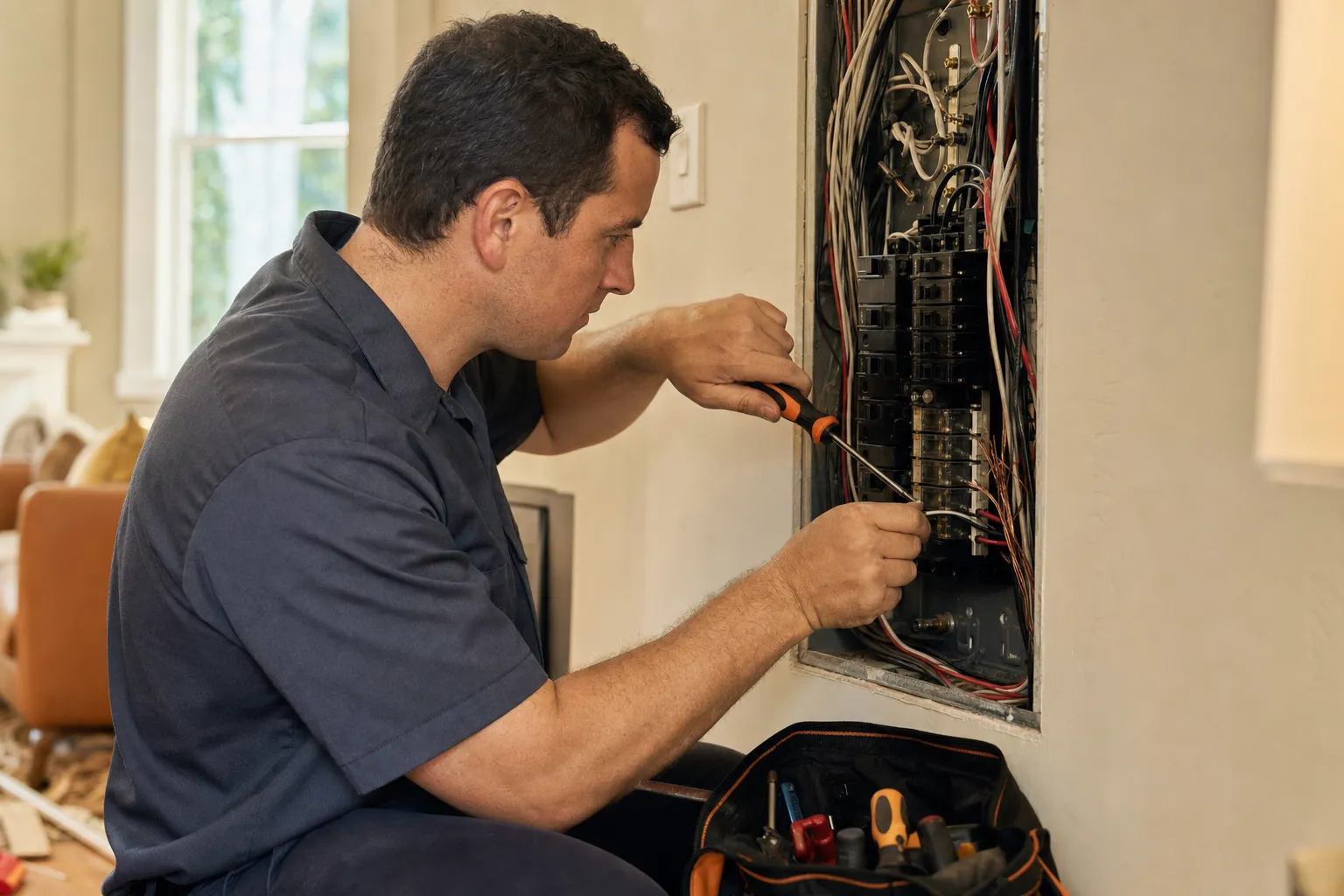
Most electricians who try online marketing hit the same wall. The leads come in, but they don't book. The phone rings, but it's someone asking for a price check who already has two other quotes. Or the call is for a city 30 miles outside the service area. Or it's a homeowner who filled out a form on a lead service and forgot they did it by the time you call back.
The Bureau of Labor Statistics projects 9% employment growth for electricians through 2034, with roughly 81,000 openings per year. Demand for residential electrical work is climbing fast, driven by aging homes, EV charger installations, solar panel hookups, and panel upgrades. The work is there. The question isn't whether homeowners need electricians. It's which electrician they find first when they go looking.
That's the gap this guide is built to close. Not a generic rundown of "invest in digital marketing." A specific look at where electrical contractors lose money online, which channels actually produce jobs that go on the books, and what to do about the ones that don't. If you've been burned by shared leads, confused by Google Ads, or frustrated that your website gets traffic but no calls, this is the breakdown.
IN THIS ARTICLE
- 1The lead services quietly eating into an electrician's profit margin
- 2Google ads that target the wrong searches waste the whole budget
- 3Local rankings shift once the map pack becomes the real target
- 4Referrals still work, but the phone goes quiet once that well slows
Keep reading to see which online channels are actually booking jobs for electricians and which ones are just moving money around.
The lead services quietly eating into an electrician's profit margin
Lead generation services sell convenience. You sign up, leads show up, and you don't have to think about marketing. That's the pitch. The reality is more complicated, and for most electricians, the math stops working once you look past the initial call volume.
The problem isn't that lead services never produce work. Some do. The problem is the structure of the transaction. You're buying access to a customer who doesn't know you, didn't choose you, and in most cases is simultaneously being contacted by multiple competitors. That changes the dynamic of the entire sales process.
A shared lead often means five other companies got the same call
When a homeowner submits a request through a lead aggregator, that request typically goes to three to five electrical contractors at the same time. Each contractor pays for the lead. Each one calls the homeowner. And the homeowner, who filled out one form, is suddenly fielding half a dozen calls from companies they've never heard of.
The result is a race to the bottom. The electrician who calls first and quotes lowest usually wins, which means you're competing on speed and price instead of expertise and trust. The profit margin on that job shrinks, and the customer has no loyalty because they didn't pick you. They picked whoever answered fastest.
The U.S. Consumer Product Safety Commission has documented that over 40,000 home fires per year are caused by problems with residential electrical wiring, making qualified electrical work a safety-critical service. Homeowners deserve to find electricians they trust, not the one who happened to answer a shared lead form three seconds faster than four competitors. And electricians deserve to compete on the quality of their work, not the speed of their callback.
A quote request is not the same as a customer ready to book
Lead services blur the line between someone who's shopping and someone who's ready to hire. A homeowner who fills out a form saying "I need a panel upgrade" might be seriously planning the project. Or they might be casually checking prices with no timeline, no budget, and no urgency.
Both scenarios cost you the same lead fee. But only one has a realistic chance of turning into a booked job. The problem compounds when your team spends 20 minutes on the phone with a price shopper who was never going to hire anyone today, while a genuine emergency call gets sent to voicemail.
The real cost of a bad lead isn't just the fee. It's the time your office staff spends chasing it, the frustration your techs feel when estimates don't convert, and the opportunity cost of not answering the next call because you were busy with a tire-kicker.
Some electricians solve this by buying "exclusive" leads instead of shared ones. That helps. But even exclusive leads still come from a third-party platform that owns the customer relationship. The homeowner searched for an electrician, found the lead service's website, and filled out the lead service's form. They don't know your name until you call. Compare that to a homeowner who searched for an electrician, found your website, read your reviews, and called your number. That second homeowner is far more likely to book.
Exclusive leads cost more but end the race to the lowest price
Exclusive leads, where you're the only contractor who receives the inquiry, are worth the premium if the alternative is fighting four other companies for the same call. But even exclusive leads from third-party platforms have a ceiling.
The homeowner's first impression is the platform, not your business. Your brand doesn't show up until you call them. And if your callback takes 10 minutes instead of 2, the homeowner has already Googled "electrician near me" and called someone else.
The long game for electricians who want to stop paying per lead is to own the channels that produce those leads. Your own Google Ads account, your own Google Business Profile, your own website, your own organic rankings. When you own the channel, you own the customer relationship from the first click, and nobody else is getting that same call.
The transition doesn't happen overnight. But the electricians who make it stop paying $30 to $80 per lead for shared inquiries and start generating calls through their own channels, where the homeowner already knows their name before they pick up the phone.
Google ads that target the wrong searches waste the whole budget
Google Ads can be the fastest source of electrical leads when it's set up right. The homeowner searches "electrician near me," your ad appears at the top, they call, you book the job. That's the best case. The worst case is that you launch a campaign, spend $3,000 in the first month, and can't point to a single booked job because the campaign was targeting the wrong searches, sending traffic to the wrong page, and had no way to measure what happened after the click.
The difference between those two outcomes is structure. Not budget. Structure.
Broad match keywords can pull in searches that have nothing to do with wiring
Google's default keyword match type, broad match, is designed to cast a wide net. If you bid on "electrician," Google will show your ad for "electrician salary," "electrician apprenticeship near me," "how to become an electrician," "electrical supplies wholesale," and dozens of other searches that will never turn into a service call.
The fix is specific keyword targeting combined with an aggressive negative keyword list. Target phrases that signal commercial intent:
- "Electrician near me," "licensed electrician [city]," "emergency electrician"
- "Panel upgrade [city]," "electrical panel replacement," "200 amp panel upgrade"
- "EV charger installation [city]," "home EV charging station install"
- "Outlet repair near me," "light switch replacement," "ceiling fan installation"
- "Whole house rewiring," "aluminum wiring replacement," "knob and tube upgrade"
- "Generator installation [city]," "whole house generator"
Then build the negative list to block the waste: "salary," "apprenticeship," "school," "training," "jobs hiring," "how to," "DIY," "wholesale," "parts," "Home Depot," "Lowes."
Check your search terms report weekly. Every irrelevant query that triggered your ad should be added as a negative. This is where the budget gets protected, and it's the step most electricians skip because they set up the campaign and forget about it.
One ad group covering every service confuses who actually clicks
A single ad group with keywords for panel upgrades, outlet repairs, EV charger installations, and emergency calls is a mess. The ad copy can't speak to all of those services at once, so it ends up being generic: "Licensed Electrician. Call Today." That generic ad is competing against a competitor whose copy says "Same-Day Panel Upgrades in [City]. Free Estimates. Licensed and Insured."
Each service line needs its own ad group with its own keywords, its own ad copy, and its own landing page. The panel upgrade ad group targets panel keywords and sends traffic to a panel upgrade landing page. The EV charger ad group targets EV keywords and sends traffic to an EV charger page. The emergency ad group targets emergency keywords and leads with "24/7 Emergency Electrician."
This structure does two things. It makes your ads more relevant, which improves your Quality Score and lowers your cost per click. And it makes your landing pages more relevant, which improves your conversion rate so more clicks turn into calls. The combined effect is fewer wasted dollars and more booked jobs from the same budget.
Without call tracking, the results are a guess instead of a number
If you can't tell which keyword, which ad, and which landing page produced each phone call, you're spending blind. Call tracking with dynamic number insertion gives you that data. It shows you that your "panel upgrade" campaign generated 8 calls last week at $42 per lead, and 5 of those calls became booked jobs. It also shows you that your "ceiling fan installation" campaign generated 12 calls at $28 per lead, but only 1 booked because the callers were price shopping for a job that doesn't cover the trip charge.
That data is what turns a mediocre Google Ads campaign into a profitable one. You double down on the service lines that produce revenue and pull budget from the ones that don't. Without tracking, every decision is a guess.
Call recording adds another layer. Listen to the calls. Is your CSR booking the leads that come in, or are good leads being lost to a slow pickup, a bad phone manner, or a failure to offer scheduling? The marketing can deliver the call. If the call doesn't convert to a job, the problem might not be the marketing at all.
Local rankings shift once the map pack becomes the real target
When a homeowner searches "electrician near me," the map pack, those three Google Business Profile listings with reviews, ratings, and phone numbers, appears before any website result. For electricians, the map pack is where the majority of local calls originate. Ranking there is a different game than ranking your website, and it requires a different set of actions.
The map pack often generates more calls than the website itself
Think about how a homeowner actually uses search results. They type "electrician near me." They see three businesses in the map pack with star ratings, review counts, hours, and a click-to-call button. Most of them never scroll past that. They tap the top-rated business and call.
Your website matters. But for the most common local electrical searches, the map pack is the front door. A strong Google Business Profile with accurate information, complete service categories, and a high volume of recent reviews will generate more direct calls than a website buried in position four or five of organic results.
Google's documentation on local ranking confirms three primary factors for local results: relevance (how well your profile matches the search), distance (how close you are to the searcher), and prominence (how well-known your business is, measured partly by reviews and web presence). You can't change your distance from every searcher. But you can maximize relevance and prominence.
Relevance means your profile is complete. Primary category set to "Electrician." Secondary categories covering your service lines: "Electrical Installation Service," "EV Charging Station Contractor," "Generator Installation Service," "Lighting Contractor." Every service listed with a description. Business description filled out. Hours accurate, including emergency availability if you offer it.
Prominence means your profile is active and trusted. Review count and average rating are the strongest prominence signals. A profile with 200 reviews at 4.8 stars will outrank a competitor with 30 reviews at 5.0 in almost every scenario. Weekly posts that mention your services and service areas reinforce relevance. Photos from real jobs, updated regularly, signal an active business.
Reviews move rankings faster than new blog posts do
For electricians trying to improve their local visibility, a focused review generation strategy will produce faster results than any other single tactic. Reviews influence map pack ranking, click-through rate, conversion rate, and LSA positioning simultaneously.
The system is simple but requires discipline:
- 1Every tech asks the customer for a review at job completion
- 2An automated text goes out within one hour with a direct Google review link
- 3A follow-up email goes at 24 hours for customers who haven't left a review
- 4Every review, positive or negative, gets a response within the same business day
Responses should be personalized. "Thank you for trusting us with your panel upgrade in [City], [Name]" includes a service keyword, a location, and a human touch. That response reinforces relevance signals while showing future customers that you're engaged and responsive.
A negative review handled professionally, acknowledging the issue and offering to resolve it, is a stronger trust signal than a wall of five-star reviews with no responses. Homeowners reading reviews notice how a business handles complaints. The electrician who responds calmly and takes ownership earns more trust than the one who ignores criticism.
A slow, outdated website can undo months of ranking progress
Your Google Business Profile links to your website. When a homeowner clicks through from the map pack to your site, what they find either confirms or destroys the trust your profile built. A site that loads slowly, looks like it was built in 2014, and buries the phone number at the bottom of the page will cost you the call even if your map pack listing looked great.
Google's web.dev documentation defines the performance thresholds: Largest Contentful Paint within 2.5 seconds, Interaction to Next Paint under 200 milliseconds, and Cumulative Layout Shift at 0.1 or below. These metrics are measured on real user devices, not on your desktop with gigabit internet.
For an electrician's website, the essentials are:
- Phone number visible and tappable on every page, above the fold
- Page speed passing Core Web Vitals on mobile
- Dedicated service pages for your core offerings: panel upgrades, EV charger installation, whole house rewiring, generator installation, outlet and switch repair, lighting, emergency electrical
- Real photos of your team and your work
- License number and insurance information visible
- Google review count and rating displayed prominently
A website doesn't need to be expensive to convert. It needs to be fast, clear, and trustworthy. Those three qualities, executed on mobile, will outperform a custom design that takes five seconds to load and hides the phone number behind a hamburger menu.
Referrals still work, but the phone goes quiet once that well slows
Referrals are the gold standard for a reason. A homeowner who calls because their neighbor recommended you is already sold. The trust is built before the first conversation. The close rate is higher. The price sensitivity is lower. No marketing spend required.
But referrals have a ceiling, and for electricians trying to grow past it, the ceiling becomes a problem.
A referral pipeline can dry up even after decades of good work
Referrals are unpredictable. A great month might bring five referral calls. The next month might bring zero. You can't control when someone's neighbor mentions your name, and you can't scale a referral pipeline the way you can scale a Google Ads budget or an SEO strategy.
The other risk is demographic. If your core referral network is in one neighborhood or one age group, the pipeline weakens as those homeowners move, age out of home ownership, or simply stop having electrical needs. New homeowners in that neighborhood have no connection to your referral network. They're searching Google, reading reviews, and calling whoever appears first.
Electricians who've been in business for 10 or 20 years sometimes discover this the hard way. The referrals that sustained the business for decades slow down, and there's no online presence to pick up the slack. Building that presence from scratch takes months. Starting before you need it is the move.
The businesses winning online are copying what referrals already do well
Here's what a referral actually provides: a trusted recommendation from someone the homeowner already believes. That's it. Trust, delivered at the right moment. Every online channel that works for electricians replicates that same dynamic in a different format.
A Google Business Profile with 300 reviews and a 4.8 rating is a referral from 300 people the homeowner has never met but trusts through sheer volume. A website with real job photos, a visible license number, and clear service descriptions builds trust the way a face-to-face conversation does. An ad that appears when a homeowner searches "electrician near me" captures the exact same moment of need that a neighbor's recommendation would.
The difference is scale. A single referral reaches one homeowner. A strong online presence reaches every homeowner in your service area who searches for an electrician, 24 hours a day, whether or not they know anyone who's used you. The trust mechanics are the same. The reach is incomparably larger.
The electricians growing fastest in 2026 haven't abandoned referrals. They've built online channels that replicate the referral dynamic at scale while continuing to earn word-of-mouth recommendations from every job they complete. The results speak for themselves: when your organic presence and paid channels work together, referrals become a bonus on top of a system, not the system itself.
A fast-answering website keeps a warm referral from calling someone else
Even referral-driven electricians lose jobs to competitors who are easier to find and faster to contact online. A neighbor says "call Johnson Electric, they did great work for us." The homeowner Googles "Johnson Electric." If no website comes up, or the website looks abandoned, or the phone number goes to voicemail, that warm referral just went cold. The homeowner searches "electrician near me" instead and calls whoever appears first in the map pack.
A strong online presence doesn't replace referrals. It catches them. When someone hears your name and looks you up, your website, your reviews, and your Google Business Profile should confirm everything the referral promised. Fast-loading site, real photos, hundreds of positive reviews, a phone number that someone actually answers. That confirmation turns a warm lead into a booked job.
The electricians losing referral leads to competitors aren't losing on quality. They're losing on findability. Fix that, and every referral you earn does its job.
Service Scalers offers a free SEO audit built specifically for home service businesses. It shows you how your site performs technically, where you rank for the searches that matter, and what your competitors are doing that you're not. No commitment. Just a clear picture of the gap between where you are and where the leads are.
Conclusion
Generating electrical leads online isn't about picking one channel and hoping it works. It's about understanding where your money is actually going, whether the leads you're paying for are the kind that book, and whether the channels you've built can catch the homeowner at the exact moment they need an electrician.
The shared lead services will keep selling convenience. Google Ads will keep rewarding the campaigns that are structured well and punishing the ones that aren't. The map pack will keep sending calls to the electricians with the most reviews and the best profiles. And referrals will keep working, right up until they slow down and there's nothing online to fill the gap.
The electrical contractors growing in 2026 aren't choosing between referrals and digital marketing. They're building online channels that work the same way referrals do, trust delivered at the right moment, just at a scale that a referral network can't match. If you're ready to build that system for your business, reach out to Service Scalers. We work exclusively with home service businesses, and the only metric we care about is booked jobs.