
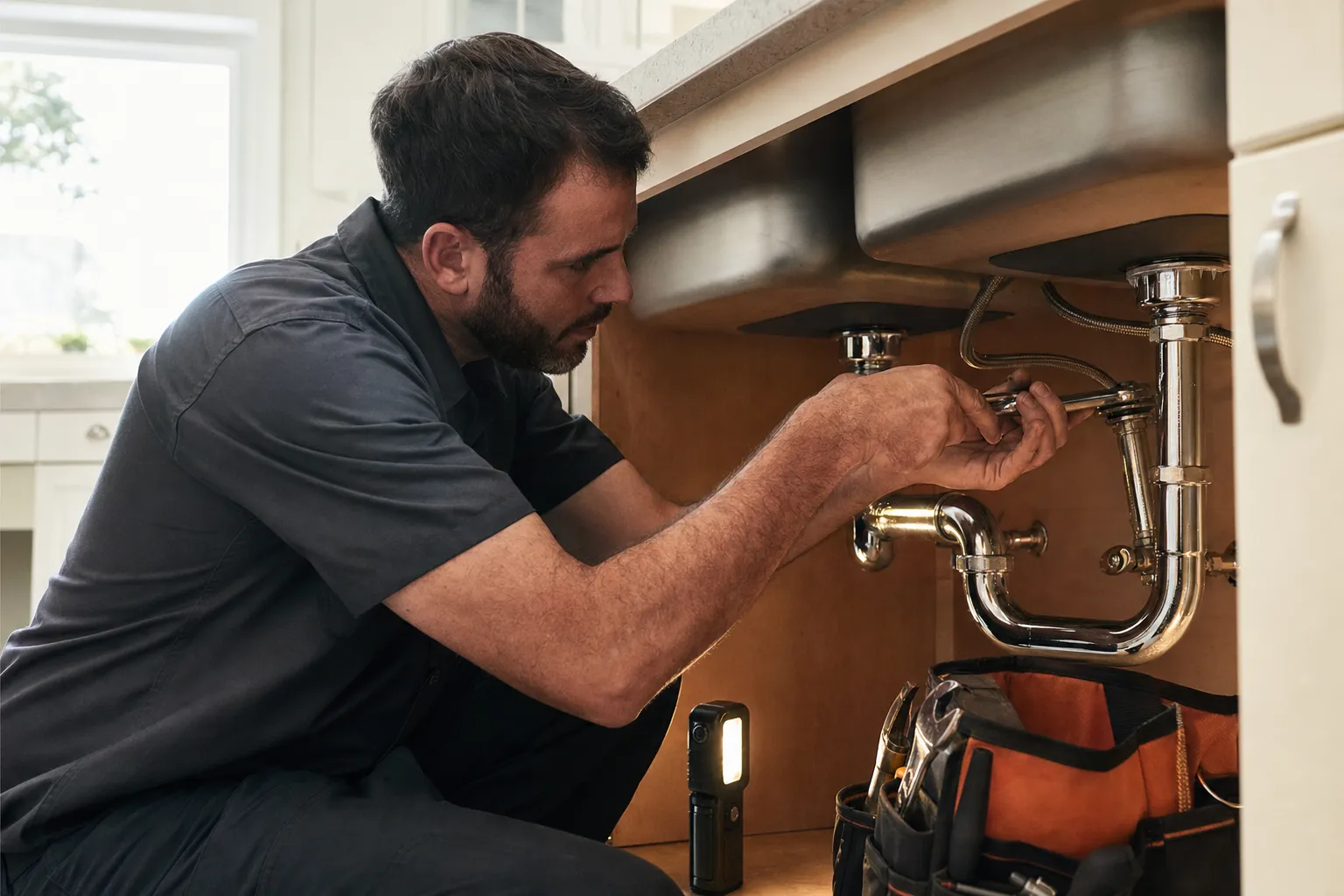
Digital marketing for plumbing companies in 2026 comes down to one question: when a homeowner's pipe bursts, toilet overflows, or water heater dies, does your business show up? Not "do you have a website." Not "are you on Google." Does your name appear at the exact moment a person with a credit card and a flooded kitchen decides who to call?
The plumbing industry is projected to generate over $190 billion in U.S. revenue in 2026, spread across more than 130,000 businesses. The Bureau of Labor Statistics projects roughly 44,000 plumber job openings each year through 2034, many driven by retirements in a workforce where the average tradesperson is over 40. Demand is strong, and it's growing. But more demand also means more competition, and the plumbing companies winning that competition in 2026 are the ones showing up everywhere the customer looks, not just in one channel.
This isn't a surface-level overview. This is the actual system, channel by channel, with the specifics you need to implement it. If you run a plumbing company doing $500K to $10M and you're serious about growth, this is your blueprint.
IN THIS ARTICLE
- 1Why single-channel plumbing marketing is dead and what replaces it
- 2How to structure Google Ads campaigns by plumbing service line with real keyword examples
- 3What makes Local Service Ads the highest-converting lead source for plumbers and how to maximize them
- 4The SEO architecture that builds compounding organic leads for plumbing companies
- 5How to run your Google Business Profile as a lead generation system, not a static listing
- 6What separates a plumbing website that converts from one that just exists
- 7How Meta Ads create plumbing demand before the pipe breaks
- 8The review and reputation system that turns every job into your next call
Keep reading to get the full playbook, channel by channel, with the level of detail you'd actually need to execute it.
Why single-channel plumbing marketing is dead and what replaces it
When a homeowner searches "plumber near me" in 2026, the results page isn't a simple list. From top to bottom, they see Local Service Ads with the Google Guaranteed badge, then paid Google Ads, then the three-pack map results from Google Business Profiles, then organic website results, and on many queries, an AI-generated overview that synthesizes answers from multiple sources. That's five distinct positions on a single page, each driven by a different system, each with its own rules.
A plumbing company that only runs Google Ads is invisible in the map pack, invisible in LSAs, and building zero organic equity. A company that only does SEO waits months for results while competitors take every call in the meantime. The companies that dominate plumbing markets in 2026 show up in three, four, or all five of those positions. When a homeowner sees the same business name in the LSA slot, the map pack, and the first organic result, the trust signal is overwhelming. They stop comparing and start calling.
The other reason single-channel fails is data. Your Google Ads campaigns reveal which keywords convert, which directly informs your SEO content strategy. Your SEO rankings feed your Google Business Profile authority. Your GBP reviews power your LSA ranking. Your website conversion rate determines whether traffic from any channel turns into a booked job. Pull one piece out and the others underperform. This is a system, and this playbook shows you how to build each piece.
How to structure Google Ads campaigns by plumbing service line
Google Ads is the fastest path to plumbing leads. You can launch today and have calls tomorrow. But "fast" and "profitable" are not the same thing. Most plumbing companies that try Google Ads on their own end up paying for clicks from people searching for plumbing supplies, DIY videos, or jobs in the trades. Profitable PPC for plumbing requires structure that separates your services, your keywords, and your landing pages so every dollar targets a homeowner ready to book.
Building the campaign by service line
Your Google Ads account should never be a single campaign with every plumbing keyword thrown into one bucket. Each service line has different intent, different cost-per-click ranges, different average job values, and different ad copy that converts. Structure them as separate campaigns or tightly themed ad groups.
Here's a working structure with real keyword examples for each service line:
Emergency plumbing is your highest-intent, highest-urgency bucket. The keywords that belong here are phrases like "emergency plumber near me," "burst pipe repair," "24 hour plumber [city]," "plumber open now," and "flooding basement help." These searches happen at 2 AM when someone is panicking. Your ad copy has to lead with 24/7 availability and fast response time. The landing page needs a tappable phone number above the fold, your license and insurance badges, and nothing that slows the visitor down.
Drain and sewer services are your volume driver. Keywords include "drain cleaning near me," "clogged drain service," "sewer line repair [city]," "sewer camera inspection," "hydro jetting service," and "main line clog." This is a broad category, so watch your search terms report carefully. "Drain" attracts DIY searches ("how to unclog a drain" and "drain snake at Home Depot") that you need to negative out aggressively.
Water heater services carry higher average ticket values than most plumbing calls. Target "water heater replacement [city]," "tankless water heater installation," "no hot water," "water heater leaking from bottom," and "water heater repair near me." The U.S. Department of Energy recently finalized efficiency standards for residential water heaters projected to save households billions per year. That's a real selling angle in your ad copy: mention energy-efficient options and potential savings to differentiate from competitors running generic "we fix water heaters" ads.
General plumbing repair covers the rest: "plumber near me," "leaky faucet repair," "toilet repair service," "garbage disposal installation," and "plumbing repair [city]." These keywords are broader, so conversion rates tend to be lower than emergency or service-specific terms. Bid them, but don't let them eat your whole budget. They're the supporting cast, not the headliner.
The negative keyword list that saves your budget
Without a negative keyword list, your plumbing campaigns will burn 20% to 40% of your budget on irrelevant clicks. Build this list before you launch, and add to it weekly based on your search terms report.
Start with these categories of negatives:
- DIY and education: "how to," "DIY," "yourself," "tutorial," "video," "home depot," "lowes"
- Supplies and parts: "faucet parts," "PVC fittings," "pipe wrench," "toilet flapper," "plumbing supplies"
- Career and jobs: "plumber salary," "plumber apprenticeship," "plumbing jobs hiring," "plumber license"
- Unrelated services: "pool," "irrigation," "sprinkler," "fire sprinkler" (unless you offer these)
- Competitors: add specific competitor brand names so you're not paying to send traffic to their branded searches
After launch, check your search terms report at least twice a week for the first month. Every irrelevant query that triggered your ad needs to be added as a negative. This is where the real money gets saved, and it's the step most plumbing companies skip because it's tedious. Tedious wins.
Landing pages that close the call
Every ad group needs its own landing page. Not your homepage. Not a generic "services" page. A dedicated page built around the exact service the searcher is looking for.
A drain cleaning ad should send traffic to a drain cleaning landing page. That page should have:
- 1A headline that matches the search ("Fast, professional drain cleaning in [City]")
- 2Your phone number, tappable, above the fold
- 3Two to three sentences on what the service includes and how quickly you respond
- 4Three to four trust signals: license number, insurance, review count and rating, years in business
- 5Before-and-after photos or a short job description from a recent drain job
- 6A form for visitors who prefer to type rather than call
- 7No navigation menu (you don't want them clicking away to explore your site, you want them to call)
The math on landing pages is simple. If your homepage converts at 3% and a dedicated landing page converts at 10%, you just tripled your leads from the same ad spend. That's the difference between a Google Ads campaign that "doesn't work" and one that books 20 jobs a month.
Conversion tracking that connects every click to revenue
Running Google Ads without conversion tracking is like running a plumbing business without invoicing. You're doing the work but you have no idea what's paying. The tracking setup for a plumbing company:
- Dynamic number insertion on every landing page, so each call is attributed to the specific keyword and ad that generated it
- Google Ads conversion tracking on phone calls (set the minimum call duration to 60 seconds to filter pocket dials and hangups)
- Form submission tracking for every contact form
- Call recording so you can listen to calls, evaluate your dispatcher or CSR, and verify whether leads are being booked
With this tracking live, you'll know that your "emergency plumber near me" keyword generated 12 calls last week, 8 of them were booked, the average job was $480, and the cost per booked job was $62. That's the data that lets you scale what's working and kill what's not. Without it, you're guessing.
What makes Local Service Ads the highest-converting lead source for plumbers
Local Service Ads sit at the absolute top of Google search results. Above paid ads. Above the map. Above everything. They carry the Google Guaranteed badge, which tells homeowners that Google has personally verified your business. For plumbing companies, LSAs are often the single cheapest source of booked jobs because you only pay when someone actually contacts you, not when they click.
Getting through verification without stalling
The verification process trips up a lot of plumbing companies. Google requires your state and local plumbing licenses, a general liability insurance certificate, and background checks on every employee who enters a customer's home. If any document is rejected, the process stalls until you resubmit.
The most common sticking points:
- License name doesn't exactly match your Google Business Profile name (even a missing "LLC" or "Inc." can cause a rejection)
- Insurance certificate doesn't list the correct named insured or has expired
- Background check consent forms weren't completed by every qualifying employee
- Business address doesn't match across your license, insurance, and Google profile
Get all your documents aligned before you start the verification process. The companies that launch in two weeks are the ones that had clean paperwork. The ones stuck in verification for two months usually have a mismatch they can't find.
Optimizing your profile once you're live
Once verified, your lead volume depends on profile optimization and review strength. The levers you can pull:
Service categories are the most important setting in your LSA profile. Select every plumbing service category that applies: drain cleaning, water heater installation, water heater repair, pipe repair, faucet repair, sewer services, toilet repair, garbage disposal, leak detection, and anything else you legitimately offer. Each category you add expands the queries your ad can appear for.
Service area should match your actual coverage, zip code by zip code. Setting it too wide wastes budget on leads outside your range. Setting it too narrow misses homeowners in cities you serve.
Hours of operation directly affect lead eligibility. A plumber listed as available 24/7 is eligible for emergency queries at midnight. One listed as 8 AM to 5 PM is not. If you take after-hours calls, say so in your profile.
Your weekly budget caps how many leads Google sends you. Start with a budget that matches your crew capacity. If you can handle 10 new jobs per week and your average LSA lead costs $25 to $50, set your weekly budget at $250 to $500. Adjust based on lead quality and booking rate.
Disputing bad leads to protect your budget
Google charges you for every lead, including the bad ones. Out-of-area calls, robocalls, wrong-service requests, and spam all get charged unless you dispute them. A disciplined dispute process recovers real money.
File disputes within 24 hours of receiving a bad lead. Include:
- Call recording proving the caller needed a different service (electrical, HVAC, etc.)
- Service area mismatch showing the caller is outside your coverage
- Caller intent mismatch (they wanted a quote for a service you don't offer)
Plumbing companies that review every charged lead and dispute every invalid one typically recover 15% to 30% of their LSA spend. At $2,000 per month in LSA charges, that's $300 to $600 back in your pocket. Over a year, it's the cost of a new tool or a month of marketing budget you didn't have to spend.
The SEO architecture that builds compounding organic leads
SEO is the one channel where every dollar you invest today keeps paying dividends for years. A service page that ranks for "sewer line repair in [city]" generates calls month after month without any additional ad spend. That compounding effect is why the most profitable plumbing companies in any market are almost always the ones with the strongest organic presence.
The catch is that SEO takes time. You won't outrank established competitors overnight. But the plumbing company that commits to a targeted SEO strategy for 6 to 12 months builds an asset that eventually generates more leads at a lower cost per acquisition than any paid channel.
Your keyword map: the blueprint for every page on your site
Before you write a word of content, you need a keyword map. This is a spreadsheet that assigns one primary keyword to every page on your site. It prevents the most expensive SEO mistake plumbing companies make: having multiple pages competing for the same keyword while leaving high-value terms completely uncovered.
Here's how to build it. List every service you offer across one column. In the next column, write the primary keyword for each service. In a third column, add two or three secondary keywords. In a fourth column, assign the page type (service page, location page, or blog post).
A plumbing keyword map looks like this in practice:
- Drain cleaning: primary keyword "drain cleaning [city]," secondaries "clogged drain service," "slow drain repair"
- Sewer camera inspection: primary "sewer camera inspection [city]," secondaries "sewer scope," "video pipe inspection"
- Water heater replacement: primary "water heater replacement [city]," secondaries "new water heater installation," "water heater upgrade"
- Tankless water heater: primary "tankless water heater installation [city]," secondaries "on-demand water heater," "tankless conversion"
- Sewer line repair: primary "sewer line repair [city]," secondaries "broken sewer pipe," "sewer line replacement"
- Leak detection: primary "leak detection [city]," secondaries "slab leak repair," "hidden water leak"
- Repiping: primary "repiping [city]," secondaries "whole house repipe," "copper to PEX repipe"
- Emergency plumbing: primary "emergency plumber [city]," secondaries "24 hour plumber," "after hours plumber"
Every row gets its own page. No two pages should target the same primary keyword. When you're done, you'll see the gaps immediately: services you offer but haven't built pages for, cities you serve but haven't targeted, and keywords your competitors rank for that you don't.
Service pages that rank and convert
Each service page on your site is both a ranking asset and a conversion tool. It needs to satisfy Google's algorithm and persuade a homeowner to pick up the phone.
A plumbing service page that actually works includes these elements:
The title tag uses the format "[Service] in [City] | [Business Name]" and stays under 60 characters. The H1 matches the primary keyword in plain, natural language. The opening paragraph answers the core question immediately: what the service is, when a homeowner needs it, and what your company does about it. The primary keyword appears in this first paragraph.
The body goes deep. Explain the process step by step. What does a sewer camera inspection actually involve? What equipment do you use? How long does it take? What do you typically find? What happens after the inspection? This level of detail is what separates a page that ranks from one that doesn't, because Google rewards comprehensive, expert content and so do the homeowners reading it.
Include a section on common signs that indicate a homeowner needs this service. For drain cleaning: slow drains, gurgling sounds, recurring backups, foul odors, multiple fixtures draining slowly. For water heater replacement: the unit is over 10 to 12 years old, rusty water, inconsistent temperatures, visible corrosion, rising energy bills. This content targets long-tail question keywords and demonstrates the real-world expertise that Google's E-E-A-T framework rewards.
Every service page needs a call to action above the fold and at the bottom. Your phone number, a booking form, and a mention of financing options if you offer them. Internal links should connect related services: the drain cleaning page links to hydro jetting, sewer camera inspection, and sewer line repair. The water heater page links to tankless installation, leak detection, and your energy efficiency blog content.
Location pages that make you visible in every city
If you serve 15 cities and your website only mentions your headquarters, you're invisible in the other 14. A location page is a dedicated page targeting "[service] in [city]" for each city in your service area.
The page needs to be unique. Not a template with the city name swapped out, which Google treats as doorway page spam. Genuinely unique content about plumbing in that specific area.
Here's what makes a location page unique and useful:
Reference the types of homes in that city. Older neighborhoods with galvanized or cast-iron pipes have different plumbing needs than new construction with PEX. Mention local infrastructure realities. The EPA estimates that millions of lead service lines still deliver water to properties across the country, and some regions face more acute pipe replacement needs than others. If the city you're targeting has known water infrastructure issues, address them.
Include reviews or job summaries from that area if you have them. Mention landmarks or neighborhoods to reinforce geographic relevance. Link to your Google Business Profile and to the main service pages this location page supports. Add LocalBusiness schema markup with the correct address, service area, and geo-coordinates.
A plumbing company with 10 service pages and 15 location pages has 150 organic entry points. That's 150 keywords where a homeowner in your market can find you. Your competitor with a five-page website has five. The math on this is straightforward.
Blog content that feeds the funnel
Blog posts for a plumbing company should never be random. Every post targets a keyword, serves a stage of the buyer journey, and links to a service page.
Three categories of plumbing blog content that produce results:
Problem-aware posts target homeowners who have a symptom but don't know they need a plumber yet. "Why is my water bill suddenly high?" "What causes a toilet to keep running?" "Is a gurgling drain dangerous?" These posts catch people at the top of the funnel, educate them, and link to the relevant service page. They also build topical authority around your core services.
Solution-comparison posts target homeowners evaluating options. "Tankless vs. tank water heater: which saves more in [city]?" "Trenchless sewer repair vs. traditional dig: cost, time, and disruption compared." "When to repair vs. replace a water heater." These are commercial investigation keywords with strong conversion potential.
Local and seasonal posts capture time-sensitive demand. "How to prepare your plumbing for winter in [city]" (published in September so it's ranked by November). "Spring plumbing checklist: 5 things to inspect after the thaw." "What [city] homeowners should know about the new water heater efficiency standards." Seasonal content published 60 to 90 days ahead of peak demand compounds year over year.
Publish two to four posts per month. Every post should be at least 1,000 words, deeply researched, and linked internally to the service page it supports. Consistency over volume. Two excellent posts beat ten thin ones.
How to run your Google Business Profile as a lead generation system
Your Google Business Profile is the most visible asset you have in local search. The map pack appears on virtually every plumbing-related local query, and the three businesses that show up there capture the majority of calls. Your GBP is not a directory listing. It's a lead generation tool that needs active, ongoing management.
Complete every field, correctly
Google states directly that businesses with complete and accurate information are more likely to appear in local search results. For a plumbing company, "complete" means:
Your primary category should be "Plumber." Not "Plumbing Service." Not "Contractor." "Plumber" matches the highest-volume search terms. Add secondary categories for every service line: "Drain Cleaning Service," "Water Heater Installation Service," "Sewer Service," "Emergency Plumber." Each secondary category expands the queries your listing is eligible to appear for.
Under Services, add every service with a description. Don't just list "drain cleaning." Write "Professional drain cleaning for kitchen, bathroom, and main line clogs. Same-day service available." This text helps Google match your listing to longer, more specific searches.
Your business description gets 750 characters. Use them. Mention your core services, your service area, your key differentiators (licensed, insured, years of experience, 24/7 availability), and a call to action. Write it for the homeowner, not for the algorithm, but include your primary services and city naturally.
Photos matter more than most plumbing companies realize. Upload real photos of your team, your trucks, your equipment, and completed jobs. Listings with photos receive significantly more engagement than those without. Update photos monthly with new job site images, team photos, and equipment shots. Never use stock photography.
Weekly posts that reinforce keyword relevance
Every GBP post is an opportunity to associate your listing with a specific service keyword and geographic area. A strategic posting calendar covers your core services across your primary cities over the course of each month.
A real posting calendar for a plumber covering four core services across three cities looks like this:
- Week 1: drain cleaning post with a job photo from City A, mentioning the specific service and location
- Week 2: water heater post from City B, highlighting efficiency upgrades or a seasonal angle
- Week 3: emergency plumbing post from City C, emphasizing 24/7 response and recent emergency call
- Week 4: sewer services post from City A, explaining camera inspection process with a real job summary
Each post includes a call to action, a relevant photo (not stock), and natural mention of the service and city. Over 52 weeks, that's 52 keyword-location associations fed directly to Google through your listing. Your competitors posting "Happy holidays from our team" once a month aren't building any of that.
Review velocity as a ranking weapon
Reviews are the most influential factor in map pack ranking outside of proximity. A plumbing company adding 5 to 10 new Google reviews per week builds an insurmountable advantage over competitors adding one or two.
The system:
- Every tech confirms satisfaction at job completion and asks for the review in person
- Within one hour, the customer receives a text message with a direct link to your Google review form
- A follow-up email goes out 24 hours later if no review has been posted
- Office staff monitors new reviews and posts a response the same day
Automate the request. Most CRM and field service platforms can trigger review texts when a job is marked complete. This removes the "we forgot to ask" failure point entirely.
For responses, personalize every one. "Thank you for trusting us with your drain cleaning in [City], [Customer Name]" is better than "Thanks for the great review!" The personalized response includes a keyword and location naturally, which reinforces your listing's relevance signals.
What separates a plumbing website that converts from one that just exists
Your website is where every channel converges. Your Google Ads send traffic there. Your SEO rankings point there. Your GBP links to it. If the site can't convert that traffic into calls, every other channel is partially wasted.
Speed is the first conversion factor
A plumbing website that takes four seconds to load on mobile is dead on arrival. The homeowner standing in a flooded bathroom on a phone with three bars isn't waiting. They're tapping back and calling the next result.
Google sets the standard: Largest Contentful Paint should occur within 2.5 seconds, Interaction to Next Paint within 200 milliseconds, and Cumulative Layout Shift at 0.1 or below. Run your site through PageSpeed Insights today. If it's failing any of those thresholds on mobile, you're losing calls to whichever competitor loads faster.
The most common speed killers on plumbing sites are unoptimized images (job photos uploaded at full resolution), too many third-party scripts (chat widgets, tracking pixels, social embeds), and cheap hosting that can't handle traffic spikes during seasonal demand.
The elements that turn visitors into callers
A plumbing website visitor decides whether to call within seconds. The elements that tip that decision:
Your phone number must be visible and tappable on every page, above the fold, without scrolling. This is non-negotiable. A plumbing website without a click-to-call button above the fold is leaving its highest-intent visitors without an easy path to conversion.
Trust signals close the gap between "I found this company" and "I'm going to call them." Display your Google review count and star rating prominently. Show your license and insurance information. Feature real photos of your team, not stock models pretending to hold wrenches. If you've been in business for 10 or 20 years, say so visibly.
Service pages need to match the visitor's intent exactly. A homeowner who clicked a Google Ad for "water heater replacement" and lands on your general services page has to figure out where to find water heater information. That friction costs you the call. Every service gets its own page with its own conversion path.
Mobile matters more than desktop. The majority of plumbing searches happen on phones, often during an emergency. If your site requires pinching, zooming, or horizontal scrolling on mobile, you're losing the exact customers who are most ready to book.
How Meta Ads create plumbing demand before the pipe breaks
Every channel covered so far captures people who already have a plumbing problem. Meta Ads (Facebook and Instagram) do something fundamentally different: they put your brand in front of homeowners before the problem happens, so when the toilet starts running or the water heater starts leaking, your name is the one they remember.
Targeting the right homeowners
Meta's audience targeting for plumbing companies should include:
- Geographic filter: only homeowners within your service area, set by zip code
- Homeowner filter: excludes renters who won't be making plumbing decisions
- Home age: older homes (built before 1980) have more plumbing issues, making these homeowners more likely to need you
- Lookalike audiences: upload your existing customer list and let Meta find people who look like your best customers
Layer these together and you're reaching homeowners in your service area who are statistically likely to need plumbing service in the next 30 to 90 days.
Creative that actually works for plumbing
Stock photos of shiny wrenches don't stop anyone's scroll. What does:
Short video (15 to 30 seconds) of your tech on a job site. The camera doesn't need to be steady. The lighting doesn't need to be perfect. Authentic beats polished every time. Show the problem, show the fix, show the happy homeowner.
Before-and-after job photos with a caption explaining what was wrong and how you fixed it. "This homeowner in [City] had a 40-year-old water heater that was rusting from the inside out. We replaced it with a high-efficiency unit in under 4 hours. They'll save an estimated $200 per year on energy costs."
Customer testimonial clips where a real customer says something specific about the experience. "They showed up in 45 minutes and fixed the leak before my basement flooded" is worth more than any ad copy you could write.
Seasonal tips that provide genuine value: "3 things to check before winter hits your pipes" or "How to tell if your water heater is on its last legs." These posts build goodwill and keep your brand in the feed.
Retargeting closes the loop
Most homeowners who see your Meta ad won't need a plumber that day. That's fine. The goal of prospecting ads is awareness. Retargeting is what converts it.
Anyone who visits your website, watches 50% or more of your video ad, or engages with your Facebook page gets added to a retargeting audience. They see follow-up ads over the next 30 to 60 days with different messaging: a special offer, a customer testimonial, a seasonal reminder.
When their drain starts backing up three weeks later, your name is the first one they think of. They've seen it in their feed five times already. That's the Meta Ads playbook for plumbing: plant the seed with prospecting, harvest with retargeting.
The review and reputation system that turns every job into your next call
Reputation management isn't a separate project. It's the engine that powers every other channel. Your Google reviews affect your map pack ranking, your LSA position, your website conversion rate, your ad click-through rate, and the homeowner's willingness to call you over the other three plumbers on the screen. A plumbing company with 47 reviews and a 4.3 rating is playing a different game than one with 400 reviews and a 4.8.
Building the system
Every completed plumbing job should trigger a review request. Every single one. No exceptions. The sequence:
- Tech confirms satisfaction on site and asks for the review verbally
- Automated text within one hour with a direct link to Google review form
- Follow-up email at 24 hours if no review has been submitted
- Optional second reminder at 72 hours for customers who haven't responded
Direct links matter. A message that says "please go to Google and find our business and leave a review" converts at a fraction of the rate of a message that contains a one-tap link opening the review form directly. Every CRM and field service platform supports direct review links. Use them.
The volume target depends on your market. In a metro of 200,000 to 500,000 people, aim for 200 or more reviews with a 4.7 or higher rating to be competitive. In a major metro, 400 or more is the competitive floor. In a smaller market, 100 well-managed reviews may be enough to dominate. Regardless of market size, the cadence matters more than the total. A steady stream of 5 to 10 new reviews per week signals to Google that your business is active, trusted, and consistently serving customers.
Responding to every review
Google has stated that responding to reviews demonstrates that you value your customers. Respond to every review within 24 hours. Positive reviews get a personalized thank-you that mentions the service and city ("Thank you for trusting us with your water heater replacement in [City], [Name]"). Negative reviews get a professional, empathetic response that acknowledges the issue and offers to resolve it offline.
A negative review handled well often converts observers into customers. They see that you take problems seriously and respond professionally. That's a stronger trust signal than 50 five-star reviews with no responses.
Consistency across platforms
Google is the primary platform, but homeowners also check Yelp, BBB, Facebook, Nextdoor, and Angi. Inconsistent information across platforms (different phone numbers, different business names, outdated addresses) erodes the trust signals that Google evaluates when ranking your listing.
Federal advertising guidelines require that claims be truthful and substantiated, a principle that extends to your online presence. If your website says "serving [City] for 20 years" but your Google listing shows you opened in 2021, that inconsistency undermines trust with consumers and algorithms alike.
Audit your presence across every platform quarterly. Claim unclaimed listings. Update outdated information. Make sure your NAP (name, address, phone) is identical everywhere.
Putting it all together: budget, measurement, and next steps
Channels don't exist in isolation. Your budget allocation should reflect the role each one plays and where your business is today.
A growth-stage plumbing company should allocate roughly:
- 35% to 40% of marketing budget to PPC and LSAs for immediate lead volume
- 25% to 30% to SEO and content for compounding organic growth
- 10% to 15% to website optimization and conversion rate improvements
- 10% to 15% to Meta Ads for demand generation and retargeting
- 5% to 10% to reputation management tools and automation
These ratios shift based on maturity. A new company with no organic presence invests more heavily in PPC and LSA in year one. An established company with strong rankings shifts budget toward Meta Ads, content expansion, and new market entry.
The total budget depends on revenue goals. As a baseline, plumbing companies investing 8% to 12% of target revenue in marketing tend to grow. Below that, you're maintaining. Above that, you're scaling aggressively.
The metrics that matter
The only report that matters for a plumbing company measures these five things:
- 1Cost per booked job, broken out by channel and by service type
- 2Total revenue attributed to marketing spend
- 3Call volume and booking rate (what percentage of calls become jobs)
- 4Average ticket by lead source (are your paid leads booking the same average job as your organic leads?)
- 5Organic ranking trajectory for your core keywords over time
Everything else, impressions, click-through rate, bounce rate, follower count, is supporting context. It helps explain the numbers above. It never replaces them.
Your playbook starts with knowing where you stand
If you've read this far and you're seeing gaps between what you're doing and what this playbook covers, you're not alone. Most plumbing companies are strong in one or two channels and invisible in the rest.
Service Scalers offers a free PPC audit that shows you exactly where your Google Ads budget is working and where it's bleeding. Built specifically for plumbing companies. No contracts. No pitch deck. Just a clear look at what's working, what's wasted, and what the opportunity looks like when the full system is running.
Conclusion
Digital marketing for plumbing companies is not one channel. It's a system where every piece reinforces every other piece. Google Ads and LSAs fill the trucks this week. SEO and content fill them next quarter and next year. Meta Ads plant the seeds that turn into calls six weeks from now. Your website converts whatever traffic every channel sends. And your reputation compounds every completed job into future visibility.
The plumbing companies running this full system don't just book more jobs. They book better jobs at a lower cost per lead, and their growth compounds because every channel feeds every other channel. The ones that pick one channel, run it in isolation, and wonder why the phone isn't ringing are funding their competitors' growth without knowing it.
If you're ready to stop guessing and start building a marketing engine that books plumbing jobs, reach out to Service Scalers. We work exclusively with home service businesses, and every dollar we manage is measured against one outcome: more booked jobs, not more meetings.